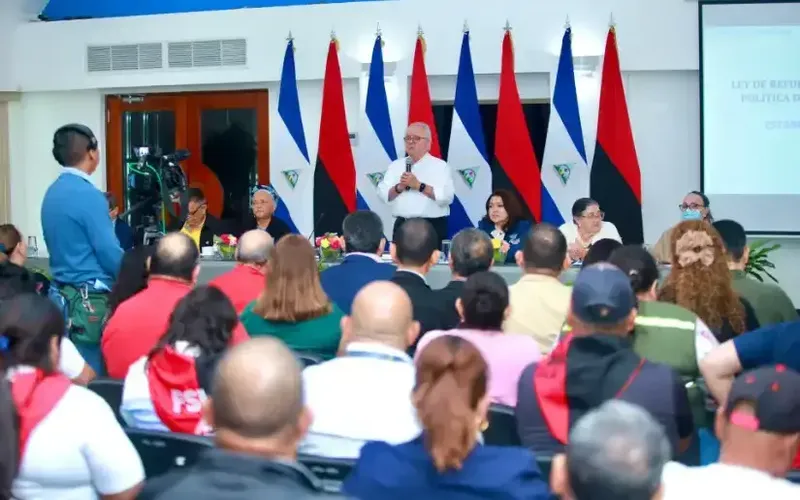
Meeting with Public Sector Workers during the Consultation Process on the Constitutional Reforms Thursday, August 13th 2026 Presentation by Dr. Gustavo Porras: We have on line connections. How many do we have? 130 on line connections. Good afternoon, friends, Compañeros and Compañeras.
Let's get started. First of all, to say thank you to all of you for being here, to all the Compañeros and Compañeras who are connected on line, a greeting. We are talking about that this afternoon we have the consultation with the State workers. We have connection with 130 places where there are Compañeros and Compañeras, as you can see in all of them, whom we also greet.
There are also Compañeros and Compañeras here, leaders of UNE, of different labor unions and workers. There are National Assembly workers and there are several other on line connections, and we also some on another floor below so that the presentation can also be transmitted to other on line connections. Our objective is to consult with you, so that everyone is clear, so that we are all clear about the content of these Reforms to the Constitution that we are promoting. Before starting, and getting on with the transmission of this consultation, I want to present the Compañeros and Compañeras, members of the Special Constitutional Commission with which we are working on this Reform.
The members of the Executive Board are part of that Special Constitutional Commission. Dr. Arling Alonso, who is the First Vice President of the Assembly. Our Heroine, our Compañera, Amada Pineda, who is the Second Vice-President of the Assembly.
And our friend María Haydee Osuna, President of the PLC and Third Vice-President of the Assembly, who have been firm in their accompaniment and in this reform that we are working on. Here too we have the Compañera Loria Dixon Brautigam, who is the First Secretary of the Assembly. Dr. Wilfredo Navarro, who is the Second Secretary of the Assembly.
Here too we have our friend Alejandro Mejía Ferretti, who is the Third Secretary of the Assembly. As members of the Committee we also have the Heads of the Political Groupings. There are three Political Groupings in the Assembly: There is the Political Grouping of the Sandinista Front, the Political Grouping of the Liberal Constitutionalist Party and there is the BID Political Grouping, which is the Democratic Independent Political Grouping, which unites parties such as the PLI, ALN, APRE. So, we have Dr.
Edwin Castro, who is the Head of the Sandinista Front Political Grouping. We have Compañero Lester Flores, who is the Head of the PLC Political Grouping and our friend Mario Asencio, who is the Head of the BID Political Grouping. We have two more members of the Special Constitutional Commission, who are presidents of Committees of the Assembly. Dr.
Auxiliadora Martínez, who is the president of the Justice Commission and Comrade Wálmaro Gutiérrez, who is the president of the Economic Commission. Here we have Compañero Domingo Pérez, who is the General Secretary of UNE. There too is Ana Yelitza, who is Co- General Secretary of UNE, little by little we are removing the title adjunct, because he is General Secretary and she is Co- General Secretary. Greetings to all who are connected on line.
This story begins when Comandante Ortega, on July 19th directed us and made public the order that there are no longer to be elections here again allowing those lying in wait, under the protection of the Yankees, to put it clearly, so as to take over the Government again, take over power and start rolling back the conquests of the Revolution. Comandante Ortega clearly said that and, well, the controversy began, you heard it all: "They say there are going to be no more elections.” Yes, he said so clearly: there are not going to be elections again allowing those seeking to return to government, seeking to return to power, come and commit their outrages. He even mentioned: "For them to come and turn education into a business." And he also said: "We are going to work with the National Assembly to make the laws to ensure this." That is precisely what we are doing. So, we set out working in that direction: We have to make the laws that allow us to put up a barrier.
The Comandante even said, "To put up a barrier, put up a wall so those people cannot come back." And that's what we're doing: putting up a wall, a constitutional barrier so they don't come back. And now we are introducing them to you. We have now made 15 presentations, we are about half way now since there are 30 in all, but each presentation is to thousands of Compañeros and Compañeras. For example, yesterday, in Education, there were 20,000 people connected on line; now there are also thousands.
Today, in the morning, there were thousands of Health Compañeros and Compañeras and so we are going to go on, until we reach the end of the month of August, because we have the proposal and we have the order, furthermore, to approve the reform for the first of September, to salute the beginning of the Month of the Patriotic Nation. So, for this work, we have identified and, furthermore, our Co-Presidents, Comandante Daniel and Compañera Rosario, have repeatedly said that the main aspiration of all Nicaraguans is Peace. Peace is the main aspiration, Peace is what we need to guarantee. But Peace also means Security, Without Security there is no Peace.
We have to keep be on high alert to guarantee Security, which will allow us the guarantee of Peace and both will allow us Stability. Those are three words that are totally related. There can be no Peace if there is no Security, and there can be neither Peace nor Security if there is no Stability. And vice versa, if there is no Peace, there is no Stability and there is no Security.
But those three words lead us to only one thing, which is the central objective that Comandante Daniel and Compañera Rosario have defined for us, and that we should all be clear about: one which unites all Nicaraguans, which is the fight against Poverty. The fight against Poverty guarantees these aspects. Why? The triumph over Poverty will give us the guarantee of these aspects, and to triumph over Poverty is to achieve definitive Independence, it is to achieve full Freedom, because Poverty is the enemy of all these things.
In other words, we have to overcome Poverty in order to have Freedom, Tranquility, Peace, Security and Stability. All these words interlink with each other to give us what we need, which is the happiness of the Nicaraguan people. With these three words we began to work, and with the central objective of poverty we began to work on the ideas for Electoral Reform. But when we reviewed matters, we realized that we needed the central historical argumentation of why we are currently working on this aspect.
Comandante Daniel always makes reference, and he made it on July 19th to the idea that Nicaraguans must understand each other here, and all this discussion is between Nicaraguans, so as to decide on the elections in Nicaragua, elections for Nicaraguans, for candidates who represent the interests of Nicaraguans and the well-being of the Nicaraguan people. They cannot be elections imposed from abroad, they cannot be elections imposed by foreign powers, they must be our elections. So, we started to review the history, which is why Wilfredo is teaching us this book called Zeledón: Life and Legacy. So why is that?
Because the fact of this very book indicates to us that our history is crossed with the history of the struggle of Nicaraguans against foreign intervention, whatever form it might take. And wherever we look, there is Rubén, we are in the Rubén Darío Meeting Room, and if we read Rubén Darío, he is absolutely anti-imperialist. His ability to write, his beauty, his grandiosity, his universality, his ability to transform Spanish letters, to develop all that modernism, is precisely marked by his being Nicaraguan, by his nationalism, by his anti-imperialism. So, everything that we are is shaped by that struggle.
Let's see where we began: We were not yet Nicaragua as a country, but already the name of Nicaragua was borne by one of our Heroes, the Cacique Nicaragua. He is the one who bore the name and who, together with the Cacique Diriangén, who are our anti-imperialist indigenous Heroes, managed to defeat the Spaniards in their first defeat on this continent. That's the reality and that's why Nicaragua is called Nicaragua, you don't have to look hard for it. That is to say, his name was Nicaragua and we know him as Nicarao and these territories belonged to Nicarao.
So, we have to be clear about that origin and that the defeat we inflicted on the Spaniards happened, it is a reality and it is documented, it was on April 14, 1500, but it was a little after they arrived, and I did learn the name of the place. And if there are people connected, from Diriamba or Carazo, they know that the struggle, that battle took place in the Quebrada del Perro, which is in Diriamba, and that today it is a street named after a Hero, but it was the Quebrada del Perro then, and everyone knows and they say so. After almost 600 years, there in the Quebrada del Perro, there we Nicaraguans, defeated Gil González, and we expelled him. He left, to return more forcefully and with other invaders.
What I mean is, that gives us our character, that gives us our social DNA, a natural DNA of struggle against intervention, a DNA of struggle and Dignity against all foreign interference. Imagine, we are talking about 1523. And after that we continued fighting, and as we have said in these last presentations, every time a foreign aggression is carried out against Nicaragua, Nicaragua responds by producing, giving birth to Heroes. In the Spanish colonialist intervention Diriangén and Nicarao appeared, and 300 years passed, Nicaragua went on producing Heroes, Heroes like Adiact, like Yarrince, like Agateyte, that is, to keep on defending all our territory.
And that's how we went on producing Heroes for 300 years. Why am I talking about 300 years? Because 300 years later we come to 1821. From 1523 to 1821, almost 300 years of struggle and the production of Heroes, and we have to go through that history so that we all have it clear.
We arrive at the day that the Independence of Central America was signed, September 15th 1821, one of the dates for which we remember September as the month of the Petriotic Nation. A formal independence was signed and formally the Spanish colonialists released the Central American Federation. But the struggle continued, since what they were trying to do was change the forms of domination because they could not sustain the one they had, and thus they began to develop oligarchies in each of the countries, which were their representatives, the oligarchs, and they chose Creole families, children of Spaniards, born here to dominate the natives or the children of miscegenation born here. That is our history, and we have been fighting since 1821 when we were divided.
They seized the Central American Federation, broke it up, the different countries were formed. Obviously, we were part of that, we were all Federated Republics, it was a federated State comprising all of Central America, and this we were formed our republics. Such that the first Constitution of our country was made public in 1838, the first Constitution of Nicaragua as a Republic. So, all this is the history of struggle against the Spanish, a history of struggle against those who tried to dominate us in the name of others, a history of struggle against the attempt to make us part of the empire in Mexico under Iturbide, a permanent history of struggle by Nicaraguans against foreign domination.
But since the time of the Spanish there was already a desire of all those who wanted to dominate us, to control the Canal, the same Canal currently provoking discussion and attacks. Why? Because the Spanish came here thinking precisely about that transit. That's documented, they entered by the River San Juan River, "the water outlet”, they called it, to reach the lake and cross there over the Isthmus of Rivas, via Brito, to reach the other side.
The English or the British, too, that is why we Nicaraguans have the medal of honor of having fought Spanish colonialism in the Pacific and British colonialism in the Atlantic. We were two engaged on two fronts and they colonized us or maintained their rule until we were liberated and we could come together as a country, but those are realities. The Canal attracted everyone. Why?
Because it made it easier for them to move from the Caribbean to the Pacific or from the Pacific to the Caribbean. While this was all happening, while we are getting rid of Spanish colonialism, while the Spanish empire was losing strength, while the British empire was also losing strength, little by little a new empire was appearing in the world and it was the North American empire that was growing. The place that one vacates is taken by another. That's a law, there are no vacuums, they are all occupied.
Or else the vacuum is occupied by the Dignity of the People from the place itself. So, there are economic and social phenomena, namely, after all, we are talking about some Peoples who were also colonized, they were British colonies, came into being, became independent, organized and began to grow. That is how they came to have their own particularities in North America, in the territory that is now the United States. There was the gold rush, the quest to move from east to west, the terrible genocide and extermination of the Original Peoples of North America, all of that.
And that made it so difficult for them to cross from East to West, to cross from the Atlantic to the Pacific, that they had to look for other ways to do so and of course, they were keeping an eye on three places: Panama, Nicaragua and the Isthmus of Tehuantepec in Mexico. Then they started making attempts, they had already started building the Panama Canal. I understand that the French were also there but at that time they also had their eye on Nicaragua. We are talking here about the time around 1838, we were already Nicaragua, we are talking about, approaching the 1850s.
So then, there was a certain businessman, Cornelius Vanderbilt, who developed a trade route, identified that this crossing was much faster than fighting a way across the land crossing and he sent filibusters, mercenaries, who apart from being filibusters and mercenaries, were well educated and prepared. William Walker was a doctor, he was a journalist, he was educated, but that does not stop him being a filibustering mercenary. At that time, he offered his services and he was sent to Nicaragua to undertake a campaign to dominate this territory, together with a soldier, Byron Cole and some mercenaries to take over the territory, all financed by Vanderbilt. Then, history followed its course and just as in the struggle for Independence against the colonialists, Nicaragua gave birth to Heroes and Heroes here as well.
During that period, Heroes and Heroes appeared like Tomás Ruiz, or Cleto Ordóñez, a true anti-oligarch popular combatant from Granada. So, every moment of Nicaragua's history produces Heroes, to defend us, against whom? Against foreign interference, that is our history. So, William Walker came, Byron Cole came, Vanderbilt's money came.
Immediately, Nicaragua produced its Heroes, who made the decision to defend it, and José Dolores Estrada appeared, other patriots appeared and after a while too Andrés Castro appeared. Nicaragua returned, fought back and managed to unite Central America after a struggle of three years until it definitively triumphed, after the Battle of San Jacinto, of September 14th 1856. We all know the Battle of San Jacinto, we know it as an epic and heroic action, but what we needed was to be told what the real background of that phenomenon was, and what was at stake there was the domination of our country to serve imperial interests. That's what they told us at school, they told us at school was that it was a battle against the filibusters, they didn't tell us it was Yankee filibusters against our patriots.
That's where Andrés Castro came to the fore, moreover, since the filibusters had rifles and the patriots had arrows, like the Indian archers, or stones, most children wanted to have the rifle. Then they would say, “No, it's just that I want to be one of the filibusters,” without knowing what it meant, because we were being taught only superficial history, they were not teaching us the true cause. Now we have the opportunity to realize that the filibusters were merely a phenomenon determined by imperialist expansionism that was seeking to dominate us, and so there we had that struggle, there we had those Heroes. We got through that, from 1856 onward, William Walker was defeated, but in Nicaragua our own contradictions continued between the conservative oligarchs who tried to maintain the archaic conservative model and new people who came with new thoughts, developing the Liberal Revolution of the late nineteenth century.
Among these new people, inspired by liberal thoughts, there was Rubén Darío, there was our other National Hero, José Santos Zelaya, there was Benjamin Zeledón himself, who was Zelaya's Minister and was a soldier in that army, and that was the way ahead. What happened? The issue of the Canal became central and Zelaya saw that this issue of the Canal was very real. Darío wrote clearly mentioning the role that the Canal played in the Yankee intervention and, by 1909, soon after Zelaya was broaching talks with the Japanese, talks with the Germans about the construction of the Canal, the Yankees said: "No, we already have the one in Panama," because they already had the Panama Canal at that point, which they already controlled.
Because we should have seen that Panama was part of Colombia and the Yankees created the necessary contradictions in order to split it off and create the Republic of Panama so as to dominate and take over the Canal. So, by 1909, the Yankees had decided they needed a second option and when they saw that Zelaya wanted to go his own way they acted, they sent some gunboats to Corinto, to Bluefields and sent a note from the US State Department called the Knox Note, which we all know about by now. That note told Zelaya: "OK, sir, step down. You can't stay in power." And there is another writing by Darío which we have come across in that regard, which clearly says, referring to the Knox Note.
Knox was a gentleman, a demon whose name is Philander Knox, he was the US Secretary of State. That's like us talking now a Rubio Note since he is now the US Secretary of State, at that time it was Knox. After all, the system is the same, only the names change. So, it was an imperialist note telling him: "You have to go." Given the gunboats Zelaya preferred to step.
He had friendships and communications with people in Mexico and went into exile and the Yankees put in Madriz. Zelaya hands power over to José Madriz leaving him as President and the Yankees arrive so as to intervene. And why go through all this history? Again, Yankee intervention, 1912.
Once again, Nicaragua reacted by producing Zeledón, that is, it produces another Hero, that was Dignity being asserted, it made him react with heroism, he began fighting the Yankees, and they murdered him. There are some very important texts that should be read, some powerful letters that Zeledón wrote before that last battle, there in Coyotepe and La Barranca, and until he was assassinated by the Conservatives. What a coincidence that the person at the head of the conservative army was a Chamorro. So, with the Conservatives and the intervention, what the Yankee does is to say: "We're going to put fear into these Nicaraguans." That’s how the Yankees think, what they think today and what they continue to do: "We are going to lauch attacks, we are going to disrupt things and disappear opponents." Aren't they saying that right now?
In other words, the actions and the arrogance of terror. So, to frighten people, at that time, they took our Hero, Benjamin Zeledon, tied his body up on a cart and paraded him through the streets of the White Towns, and dragged him through Catarina. And that led Nicaragua to produce the Father of the Revolution, the greatest Hero we have, the person who has guided us to be here: Sandino. Sandino was present there.
The Yankees expected that all the young people and the whole population would be terrified and that, at a stroke, that would give them domination. But what happened was that it outraged Sandino and Sandino vowed to fight, and that light emerged from among the Nicaraguan people. So we arrive at 1912. There were several internal struggles, but in fact, the Conservatives prevailed, who are the ones calling for US intervention.
Adolfo Díaz controls the government, as President Díaz and so we get to 1923. But let's remember all of this we are reviewing is in order to realize that the history of the Nicaraguan people is a history of permanent struggle against foreign powers. We have been formed that way, whether we like it or not. We heard so many things.
I, kid, I remember that there were even songs, sayings that accustomed us to the idea of the foreign invasion. Rubén Darío put it in a book but we heard it too. We used to say, "Colorado came down from the sky like a sonchiche," and we talked about, "Gardena Sanamambiche." We were were talking about popular songs referring to Yankee airplanes. We must remember these things, because they are the expressions of what the People keep in their hearts.
The people keep that resentment of foreign rule in their hearts. So, the Yankees came here in 1923, they took the decision to look for more effective forms of domination than the more brutal ways like war, destruction, death. And there are more effective forms of domination: if you have a country and you control the head of the government you can apply laws so that they serve your objective. So that's what they did.
In 1923, they decided that Nicaragua had to be re-made in the image and likeness of the Yankee model. And that means the Yankee model as a bipartisan model, which is the one that still exists today. There are Liberals and Conservatives; in the US they are called Democrats and Republicans. So, in Nicaragua they decided we had to have a similar model, which is one of Liberals and Conservatives, and they sent a man named Harold Dodds.
If you take your smart phones and go into the search engine, put: "Dodds Law" and they will show you Electoral Law in Nicaragua, made by a Mr. Harold Dodds, who was an American sent by a Yankee President to make the Electoral Law in Nicaragua. Here is Dodds Law and that law established for the first time the National Council of Elections, what we know today as the Supreme Electoral Council, and it was a law that was aimed exclusively, from a legal point of view, to set up a framework so that there would be two parties, Liberals and Conservatives. But this was not what we were taught, we came into the world as we found it, and came to see that there were Liberals and Conservatives and we believed that life was like that.
In addition, we were taught it as the historical parallels: Liberals, Conservatives, with the idea being that over time, first the Liberals, then the Conservatives, and that there would be an “alternation in power”, in quotes. So, here is an example of what the official ballot paper was at that time. This law was made during the presidency of Adolfo Díaz, who was the one who had requested the Yankee intervention. This ballot paper tells us that there is a Conservative Party, a Nationalist Liberal Party, and the Conservative Party, its candidate for President was Adolfo Diaz and there is the Nationalist Liberal Party, whose candidate was Juan Bautista Sacasa.
Both of them, to be regarded with reserve: the first brought the Yankees and Juan Bautista Sacasa is the one who invited Sandino to his last supper so that later he would be murdered. That is, the Yankees were the ones in command, either way. Win, win, for them: Win with the first, they already knew how it would be, and if the other were to win, they also also already knew how it would be. That is to say, that was the characteristic of our political life: foreign rule.
A series of events followed after 1923. There was the period of the war of the Constitutionalist Army under Moncada. So, the Yankees saw this mature, and then when the Liberal Army was dominating the war, the Yankees saw their moment and imposed themselves. The Yankees say: Well, let's see, Moncada to lay down your arms we are going to make the Espino Negro Pact, the Moncada-Stimson Pact.
So, there was Moncada and there were the Yankees, whereby you will give us the weapons of the army that was winning, and they could shake on that. Thus, we’ll give you a dollar for a rifle, but we also guarantee that next year you will be President, that was on May 4, 192seven. May 4th 192seven, if this were all that had happened, would have been the day of ignominy, but why do we call it the Day of National Dignity? Because there was a General of the Constitutional Army, of the Liberal Army, who said, "No, I'm neither selling out nor giving up." And it was that boy who had sworn after having been outraged to see Zeledón’s body being abused by the Yankees.
So then it was Sandino who says: "No, I'm neither selling out or surrendering" and given that he did not accept surrendering he set off with 30 compañeros. A month and a few days later after refusing to surrender, he declared in his Manifesto of San Albino, on July 1st 192seven: "Here the struggle is not between ourselves, it is against the Yankees and their lackeys and their traitorous sell-outs," and he sets out well what the path is, identifying for the first time what the contradiction was that had to be resolved: the struggle against American intervention. So, Sandino took his side, and the Yankees continued with their plan. In 1928, to comply with the Espino Negro agreement, the Yankees brought in US Marines, specifically to take over the electoral process, that is, so that those US marine officers would be the polling station Presidents, the heads of electoral districts throughout the country, at the departmental level and at the local and national levels.
And they said, "This is how the elections are going to be." But, all those arrangements needed a command. They were not going to have a Nicaraguan in charge so they decided that General Frank Ross McCoy was going to be the President of the National Electoral Council, and that's what they did in 1928, why? To ensure the presidency for Moncada. So, they occupy the Dodds Law, they do the trick, but in order to do this thing about the Yankees being the ones who run the entire electoral process, they make another law: This is the Dodds Law and this is the McCoy Law.
The McCoy Act is called the 1928 Act, and this is the Dodds Act, the 1923 Act. This is the one they occupy, but then they do this one to put it on hold, to occupy the ring, the electoral framework, but to give it the characteristics that the Yankees were going to make the elections. Look at what the Dodds Act says. It's brutal and it was shocking.